
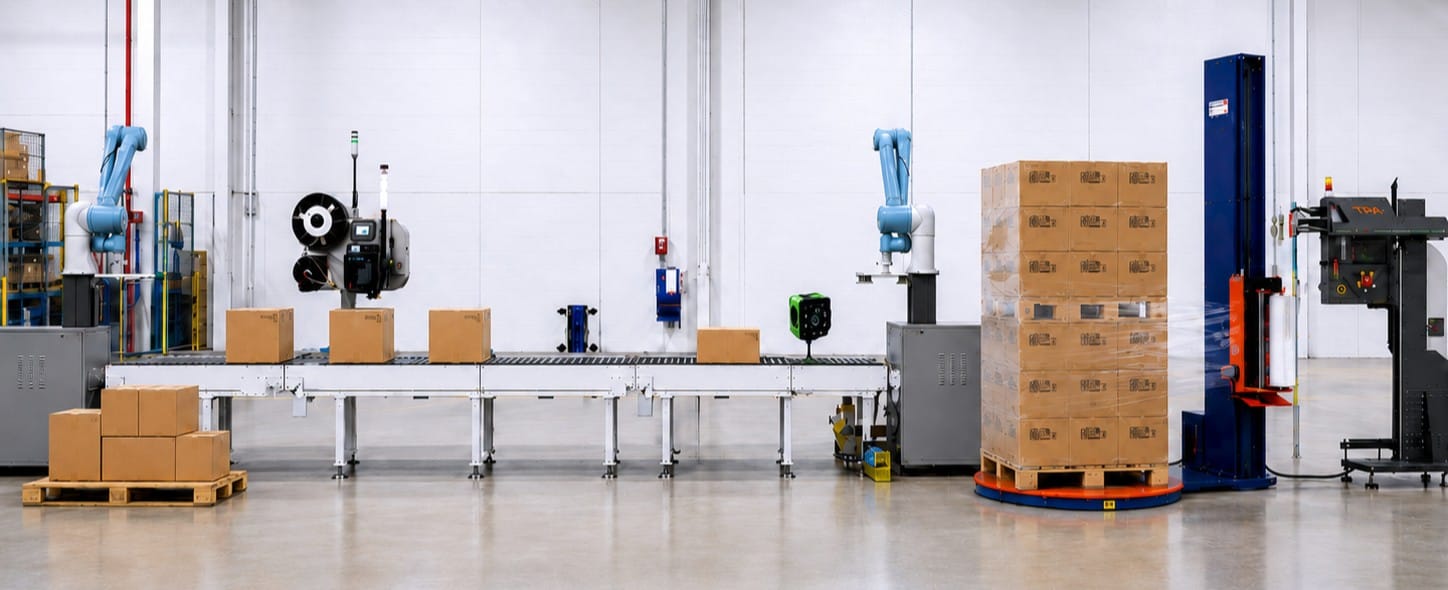
It is no longer a question of if your warehouse will become automated, it is a question of how and whether you or your competitors will be at the forefront of innovation.
For UK businesses logistics and end of line operations are already being transformed to enhance sustainability, optimise labour resources, nd fully realise the benefits of AI and automation for efficiency and employee wellbeing.
1. Automation: fewer errors, faster throughput, better use of labour resources
Human activity in the warehouse is changing. Less focus on manual, repetitive tasks (that cause injury, avoidable errors, and boredom). They are moving over to oversight, management and money-making, business-critical activities that they actually want to do! The warehouse of the future (though you won’t be surprised to learn that for some of your competitors it’s already the reality) is automated robotic solutions. That works alongside your workforce, not replacing it.
The future is:
- An automatic palletiser which boosts throughput, reliability, and can be up and running in less than 60 minutes, specifically programmed to handle your exact carton requirements, however delicate.
- Shrink wrappers which are self-propelled, mobile and handle all pallet shapes and sizes with ease
- Innovative robotics integrated with ERP and WMS systems to be full End of Line Systems, which improve efficiency, reducing your costs by up to £700,000 per annum.
However, it is still remarkably common (84% of small businesses avoid automation tools according to UK government reports) to utilise expensive labour resources for repetitive manual tasks.
In theory, you can understand why.
Automation is ‘expensive’ or ‘difficult to implement here’ is a common thought. But many solutions are subscription-based, requiring no capital expenditure.
But not automating masks a multitude of hidden costs, including but not limited to slower output, fatigue, injuries and recurring recruitment fees due to high attrition rates. As any HR professional will tell you, the ‘perfect’ employee never stays for long, leading to high recruitment costs and irritating downtime as you train up someone new.
Automation does not mean replacing everything at once. The future automated warehouse is flexible and adaptable to your needs, not just an out-of-the-box solution. A modular approach is just as innovative and allows for a focus on business-critical improvements today whilst future-proofing as you scale.
2. Smarter finances: robotics-as-a-service has never been easier
It is not just the equipment and the role it is performing in your operation that is changing. It is how the equipment arriving at your site is financed and how quickly it can make you a return on your money!
Imagine a world where your capital isn’t tied up in expensive assets. Subscription models and leasing are democratising automation. It isn’t just the Amazons of the world who can have the smart warehouses of the future. Smaller operations can have the benefit of automation whilst conforming to their cash flow requirements and their strategic direction. It will allow for dynamic working, stable business scaling and flexibility in production demand.
An added benefit is the fixed monthly expenses that are predictable, rather than the uncertainty of whether overtime payments or expensive agency fees will need to be costed when there is a lag in productivity or sickness/injury call-out.
You lease/rent your car; why wouldn’t you lease/rent automation today that will save you money tomorrow? An ROI before you’ve even fully invested, and typically at a fraction of what the commensurate rate would be.
3. The Future Power of AI
Data-driven AI, combined with IoT, can enable real-time inventory tracking, demand forecasting and predictive maintenance. That means better resource allocation, faster response times and stronger service levels, even when demand is unpredictable and delivery expectations keep tightening. The competitive delivery times of yesterday are likely to become tomorrow’s minimum standard.
But AI isn’t just analysing.
No.
It will go far beyond this to active decision-making to revolutionise your operation into the ultimate efficient environment.
The insights AI has gained from its analysis, along with its integration with robotics, enable real-time adjustment and decision-making in response to unexpected events, ensuring agility and responsiveness in the fastest-moving of environments.
The future is AI increasingly orchestrating and planning complex tasks, making real-time decisions and supporting your operation with less human intervention, improving accuracy, responsiveness and efficiency while saving you money.
Fulfilment becomes more streamlined, intelligent and efficient, with automation helping to reduce errors and respond to unexpected changes in real time.
4. Your warehouse: less waste, greener operations
The plethora of available equipment will be at the forefront of environmental practice, from all-electric label applicators, which save £ 3,000 per line per year in energy costs, to direct-to-box printing solutions, which eliminate the need for single-use labels.
The warehouse of the future is green, with environmental considerations at the forefront of every decision, not an afterthought tick-box exercise for CSR policies.
Waste reduction is going to be one of the single biggest areas to explore. Reducing space requirements has a direct correlation to CO2 emission reduction. Anywhere that space is not being optimised is an opportunity to reduce your emissions by up to 100,000 kg of CO2 and get on the carbon front foot.
The Takeaway: the future of warehouse automation is intelligent, sustainable, flexible to your needs and will almost have you thinking it is managing itself.
Ready to take your Warehouse into the future? Receive our ROI Workbook by submitting the form below and see how much you could save!