Northamptonshire Businessman of the Year and Entrepeneur Solves the Labour Crisis in Warehousing and Logistics
What was once foresight has now become fact.
According to the British Chambers of Commerce, 62% of organisations reported experiencing skills shortages in 2024, while the Learning and Work Institute estimates those shortages could cost the UK economy £120 billion by 2030!
The issue is not widely recognised across both industry and government, with labour availability, both skilled and temporary, becoming a central theme in Britain’s economic growth strategy. The end of free movement has also drastically reduced the number of EU migrants entering the workforce, despite EU workers previously making up around 20% of a typical UK warehouse workforce, further tightening an already constrained labour market.
For many businesses, the equation has become painfully familiar.
Wasted Labour + Skills Shortages + Stunted Growth = Operational Chaos
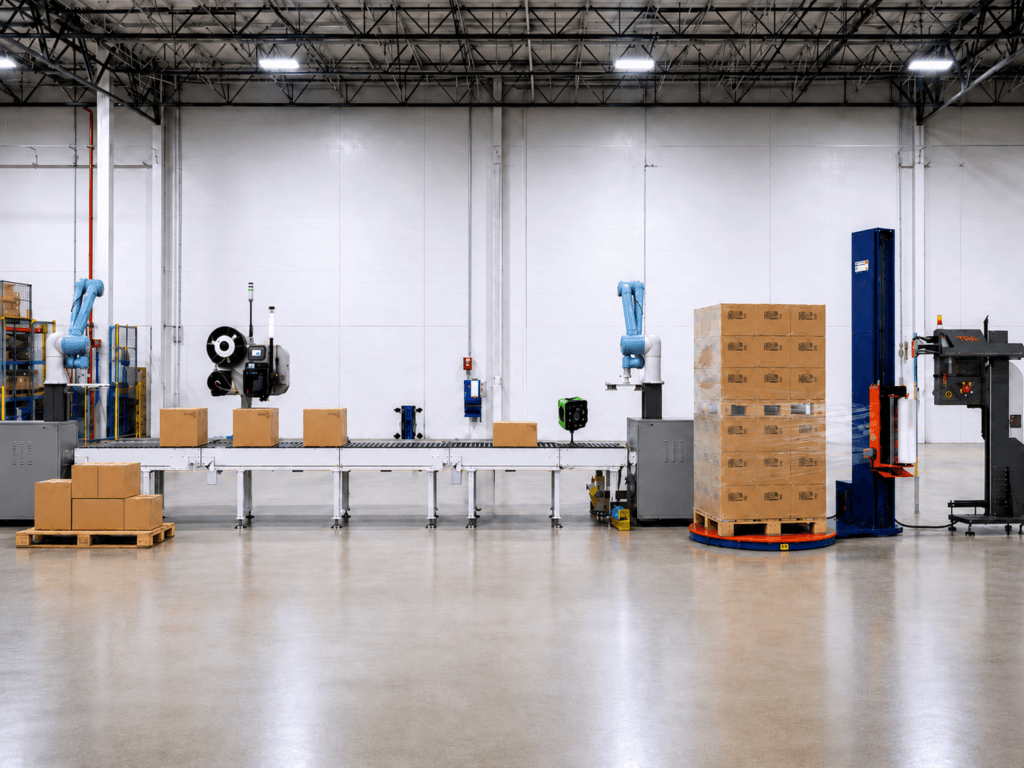
A fully modular end-of-line automation system that integrates every critical stage of outbound product handling into one intelligent system.
The automation system can help realise savings of up to £700,000 per year, per line by reducing labour and operational costs! Even implementing a single module can save at least £62,000!
The solution includes:
- Robotic Automated Palletising and depalletising
- Box-carton label applicator
- Direct-to-box printing, eliminating traditional need for labels
- Automatic quality verification, including barcodes and QR codes
- Stretch pallet wrapping
- Automated pallet labeller
What makes this so unique is its flexibility. No other provider currently offers a fully comprehensive end-of-line solution that can be configured to fit virtually any existing production or warehousing setup. Unlike rigid automation systems that require major operational redesign, i-Mark’s solution is completely modular.
How End-of-Line Automation Delivers Measurable Savings
A typical operation that operates:
- 5 days per week | 2 shifts per day | 8-hour shits | 2 operators per shift
Businesses can generate savings of up to £700,000 per year, factoring in reduced errors, lower waste, fewer product recalls, improved throughput, and increased dispatch efficiency.
Businesses can deploy the full system or select only the components they need, allowing automation to be introduced without disrupting existing infrastructure. That flexibility makes adoption faster, lower risk, and significantly more cost-effective. The commercial impact is substantial.
The potential benefits extend beyond labour reduction alone. Automation at the end of the line can help businesses reduce repetitive manual handling, improve traceability and quality control, and create more consistent throughput across production and warehousing operations. For businesses facing a labour shortage, it may also provide a more practical route to scaling output without a proportional increase in staffing.
The case for automation is no longer driven solely by efficiency.
Rising employment costs, including higher employer National Insurance contributions, increased wage pressure, and ongoing recruitment challenges, are forcing many businesses to re-evaluate labour-intensive processes. For warehouses and manufacturers operating on tight margins, reducing dependency on manual end-of-line tasks in increasingly becoming a commercial necessity rather than a long-term ambition.
-
- “Six years ago, I warned that labour inefficiency and skills shortages would become defining challenges for the British industry. That challenge is now here. The difference today is that we have a solution. I-mark’s system allows businesses to dramatically reduce labour dependency, redeploy resources, improve efficiency, and future-proof operations without rebuilding their entire production environment.”